
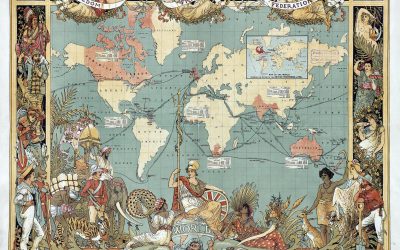
The Pax Britannica, Latin for “British Peace,” describes the period between 1815 and the outbreak of World War One in 1914. During this time, the British Empire achieved global hegemony, exerting its influence and control over a large portion of the world. This era was characterised by relative stability and peace, with the British Empire becoming the dominant global power and adopting the role of a “global policeman.”
In this article, we will delve into the various aspects of Pax Britannica, exploring its origins, the factors that contributed to its rise, and the subsequent challenges that led to its eventual decline.
Origins of the Pax Britannica
The origins of the Pax Britannica can be traced back to Napoleon’s final defeat in 1815. With the end of the Napoleonic Wars, Britain emerged as a global superpower without any serious international rival. The British Royal Navy had become the largest naval presence on the seas, enabling Britain to dominate global sea trade routes and remain primarily unchallenged for the rest of the 19th century.
The Congress of Vienna, held in 1815, helped solidify Britain’s position as a global power. European diplomats convened to create a new balance of power in Europe following the French Revolution and the Napoleonic Wars. As a result, Britain gained valuable colonies, including Malta, the Cape of Good Hope in South Africa, and Ceylon (now Sri Lanka).
Colonial and naval dominance
With the loss of the American colonies after the American Revolution, Britain turned its attention towards Asia, Africa, and the Pacific, embarking on a path of colonial expansion. The defeat of the French in 1814 and the subsequent Congress of Vienna opened the doors for Britain to expand its empire without significant opposition from other European powers.
During this time, Britain’s influence in Asia grew, starting with the annexation of Ceylon in 1815. Beyond its formal empire, Britain also controlled trade with several countries, including China, Siam (now Thailand), and Argentina. In 1820, Arab leaders agreed to Britain’s protection of the Persian Gulf through the General Maritime Treaty, further expanding British influence in the region.
The Royal Navy was superior to any other two navies in the world combined. Between 1815 and the passage of the German naval laws of 1890 and 1898, only France posed a potential maritime threat to Britain.
The Industrial Revolution and free trade
The Industrial Revolution, which began in Great Britain in the late 18th century, played a significant role in the growth of the British Empire. New ideas about free markets emerged, such as Adam Smith’s The Wealth of Nations (1776), which argued for the benefits of free trade. By the 1840s, Britain had adopted a free trade policy, enabling it to trade goods and capital extensively with countries around the world.
The development of new technologies, such as the steamship and the telegraph, further bolstered British imperial strength. These innovations allowed Britain to control and defend its vast empire more effectively.
The British Empire and the world

During the Pax Britannica, the British Empire played a significant role in shaping global affairs. The Empire’s extensive trade and communication network, along with its military and naval dominance, allowed Britain to exert its influence in various regions, including Asia, North America, Oceania, and Africa.
The British Empire also played a crucial role in the Americas. It supported the United States in upholding the Monroe Doctrine, which maintained American economic dominance in the region.
The Royal Navy as a global force
The Royal Navy, as the world’s largest and most powerful naval force, provided various services to other nations during the Pax Britannica. These services included suppressing piracy, blocking the slave trade, and protecting global trade routes. The British government even negotiated international treaties to enforce the ban on the slave trade following the passage of the Slave Trade Act in 1807.
However, it is essential to note that sea power alone did not guarantee success on land. Conflicts like the Crimean War, the Franco-Austrian War, the Austro-Prussian War, and the Franco-Prussian War were fought between major powers during this era.
Challenges to the Pax Britannica
Despite the relative peace and stability of the Pax Britannica, several challenges emerged throughout the 19th century that would ultimately lead to its decline.
The breakdown of the continental order established by the Congress of Vienna strained relations between Europe’s great powers. Issues such as the decline of the Ottoman Empire and the emergence of new nation-states like Italy and Germany led to conflicts like the Crimean War and the Franco-Prussian War.
Additionally, the industrialisation of countries like Germany, Japan, and the United States contributed to the relative decline of British industrial supremacy in the late 19th century.
The end of the Pax Britannica
The outbreak of World War I in 1914 marked the end of the Pax Britannica. However, the British Empire remained the largest colonial empire until the beginning of decolonisation after World War II in 1945.
Britain continued to be a leading power until the Suez Crisis of 1956, during which British and French troops were forced to withdraw from Egypt under pressure from the United States and the Soviet Union.
The Pax Britannica was a period of relative peace and stability during which the British Empire became the dominant global power. This era was characterised by British colonial and naval dominance, the Industrial Revolution, and the promotion of free trade.
However, the Pax Britannica had its challenges, and the emergence of new global powers, along with various conflicts, eventually led to its decline. The start of World War One in 1914 marked the end of the Pax Britannica, but its impact on global affairs and the shaping of the modern world remains a crucial part of history.


Leave a Reply