
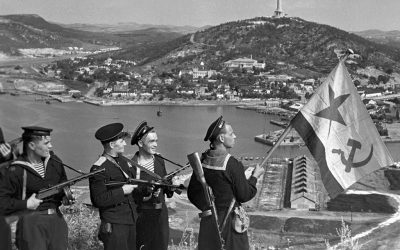
The Soviet Union was a socialist state that spanned across Eurasia from 1922 until its dissolution in 1991. Its origins can be traced back to the 1917 October Revolution, led by the Bolshevik party under Vladimir Lenin’s leadership. This revolution ousted the Provisional Government that had been in place since February and paved the way for the establishment of Soviet governance.
Political structure
The political structure of the Soviet Union was characterised by a one-party rule with the Communist Party of the Soviet Union (CPSU) at its helm. This centralised system saw power resting primarily in the hands of key party officials. The highest authority in the USSR was the Politburo, which consisted of a select group of CPSU members who were responsible for crafting policy decisions.
Watch the video or continue reading below.
Economic system
The economic system underpinning the Soviet Union was shaped by Marxist-Leninist principles, reflecting a planned economy. This meant that all aspects of production, distribution, and exchange were controlled by the government. Goals and quotas were set by central planners (Gosplan) under a series of Five-Year Plans, which aimed to drive rapid industrialisation and collectivisation in order to achieve economic growth and self-sufficiency.
International relations

At its inception, the Soviet Union faced scepticism and hostility from Western capitalist nations. The ideological divide between communism and capitalism defined much of international relations during this period. During World War II, however, an alliance between Joseph Stalin’s USSR, Franklin D. Roosevelt’s United States, and Winston Churchill’s United Kingdom was forged against Germany and its Axis Powers.
The later onset of the Cold War saw tensions escalating once more between East and West as competing superpowers clashed for global influence. The Soviet Union orchestrated a series of geopolitical moves, including propagating communism to other countries and launching an arms race against Western nations.
Human rights record
The Soviet Union’s human rights record is often criticised for its widespread disregard for civil liberties and political freedoms. Under Joseph Stalin’s regime, millions of citizens were subjected to forced labour in gulags, executed, or perished during famines induced by policy mismanagement.
Even after Stalin’s death, repression persisted under subsequent leaders, with pervasive surveillance of the population and crushing of political dissent. Reliance on authoritarian rule meant that freedom of the press, artistic expression, and religion was severely restricted during most of Soviet history.
Dissolution
By the 1980s, the Soviet Union had become burdened by systemic issues, including economic stagnation and societal discontent. The reformist attributes of Mikhail Gorbachev’s leadership brought about the policies of perestroika (restructuring) and glasnost (openness), helping to lay the foundation for democratisation.
These measures, however, proved insufficient to address deep-rooted problems within the USSR. A combination of nationalist movements in Soviet republics, economic instability, Western pressure (especially from Ronald Reagan’s United States), and internal disarray within the CPSU contributed to the eventual dissolution of the Soviet Union on December 26th, 1991.
Soviet Union States
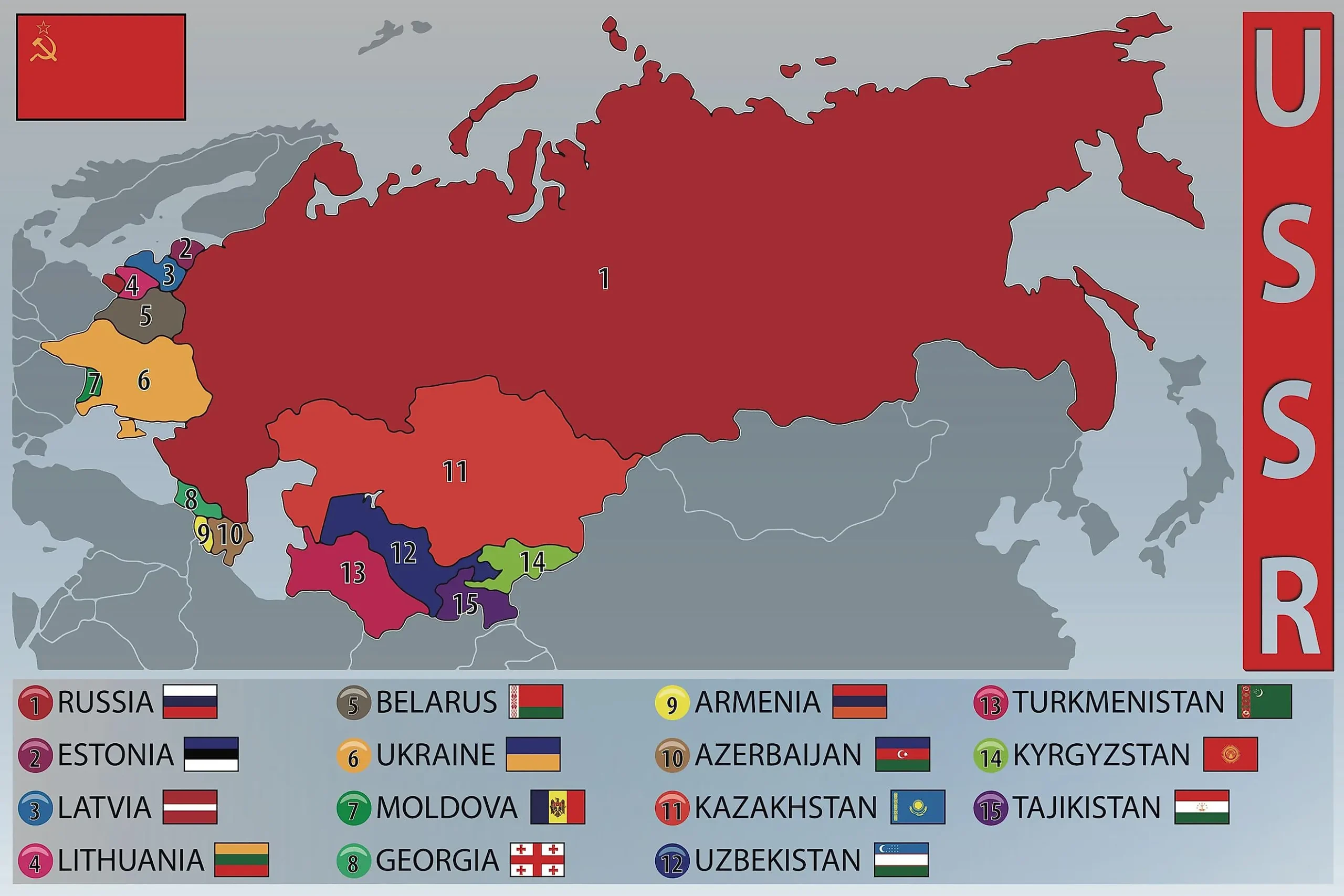
The Soviet Union, at its dissolution in 1991, consisted of 15 republics that became independent countries. These countries are:
- Russia: The largest and most influential of the republics, Russia was the core of the Soviet Union. Its capital, Moscow, was also the capital of the USSR.
- Ukraine: A key republic with significant agricultural and industrial resources, Ukraine also held strategic importance due to its size and location.
- Belarus: Located west of Russia, Belarus was an important industrial and agricultural centre in the Soviet Union.
- Uzbekistan: In Central Asia, Uzbekistan was known for its cotton production and as a crossroads of various cultures.
- Kazakhstan: The largest Central Asian republic, Kazakhstan was significant for its vast mineral resources and as a site for Soviet space endeavours.
- Georgia: Located in the Caucasus region, Georgia was known for its diverse culture and history, as well as its agricultural products.
- Azerbaijan: Also in the Caucasus, Azerbaijan had significant oil resources which were crucial to the Soviet economy.
- Lithuania: One of the three Baltic states, Lithuania was annexed by the Soviet Union during World War II.
- Moldova: Located between Romania and Ukraine, Moldova included significant cultural influences from both Eastern Europe and the Soviet Union.
- Latvia: Another Baltic state, Latvia was known for its seaports and was a significant trading hub.
- Kyrgyzstan: A mountainous country in Central Asia, Kyrgyzstan had a predominantly rural economy within the Soviet Union.
- Tajikistan: Also in Central Asia, Tajikistan was noted for its agricultural production, particularly cotton.
- Armenia: A small republic in the Caucasus, Armenia has a rich cultural history and was an important industrial producer in the USSR.
- Turkmenistan: Bordering the Caspian Sea, Turkmenistan is rich in natural gas and oil resources.
- Estonia: The northernmost of the Baltic states, Estonia had a mixed economy and was more economically and culturally aligned with Northern Europe.
Each of these countries has pursued its own path since the breakup of the Soviet Union, with varying degrees of political, economic, and social transformation.
In summary, the Soviet Union was a state defined by its socio-political experiment in Marxist-Leninist socialism. It survived a tumultuous history characterised by intense global political competition and periods of severe domestic repression. Ultimately, however, it crumbled under the weight of its economic and political challenges in the final decades of its existence.


.jpg)
Leave a Reply