• Skip to main content
  • Skip to after header navigation
  • Skip to site footer
Our history archive

Our History

Our History Archive, where history comes to life

  • Home
  • Colonisation
  • World History
  • Civil Rights
  • World cultures
  • Features
  • Wellbeing
  • Popular Culture

Spanish colonisation of Mexico: A tale of destruction and coercion

The colonisation of Mexico
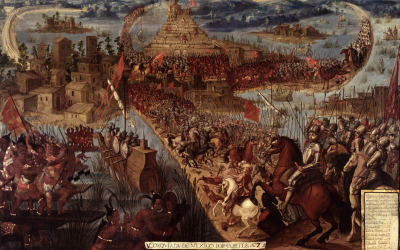
From the Conquest of México series. Depicts the 1521 Fall of Tenochtitlan by Spanish Conquistador Hernán Cortés, in the Spanish conquest of the Aztec Empire. (See page for author, Public domain, via Wikimedia Commons)
Colonisation
1 April, 2020

The colonisation of Mexico was a transformative period marked by exploration, conquest, and the establishment of Spanish rule in the region. At its core lies the invasion of the Aztec Empire by Spanish conquistadors during the early 16th century, which resulted in political domination and cultural destruction. As European colonisers imposed their customs, religion, and way of life upon the indigenous people in pursuit of wealth and development, it led to the near destruction of centuries-old traditions, forced conversion to Christianity, and even several uprisings against the oppressive regime.

Before we delve into the journey of Mexican colonisation, it is essential to understand the rich cultural tapestry that preceded this era. The indigenous people of Mexico enjoyed highly developed societies with intricate religious practices, art forms, architecture, and agricultural techniques. However, as Spanish conquistadors arrived on foreign shores in search of gold and glory, they soon found themselves at odds with a people who fiercely resisted their intrusion.

One cannot discuss the colonisation of Mexico without mentioning Hernán Cortés. This ambitious Spaniard led an expedition of around 500 men in 1519 to explore present-day Mexico and formed alliances with different Indigenous groups dissatisfied with Aztec rule. Behind Cortés’ success lay his calculated strategy: exploiting rivalries among natives to weaken their resistance. Such tactics allowed him to establish control over various regions gradually.


The most devastating effect on native traditions was the imposition of Christianity on the indigenous peoples. The Spanish adopted a “spiritual conquest” policy, whereby converting locals was crucial for maintaining control over conquered lands. Missionaries would accompany military forces under the guise of spreading Christian faith, allowing them to engage natives who were initially hostile towards them.

Abbeys and monasteries replaced ancient temples as centres of religious activity, and indigenous spiritual practices were actively suppressed. Able to justify their dominance with the conviction that they were saving souls, numerous missionaries showed no qualms about forcibly converting natives. To quell dissent and encourage conversion among the masses, traditional rituals or celebrations were often deemed demonic by Spanish priests.

Resistance was inevitable, and there were several instances of indigenous revolts against Spanish rule. One such uprising was the Mixtón War (1540 – 1542), where a coalition of native tribes from Western Mexico launched an armed revolt against their colonial oppressors. Despite their initial success in retaking parts of their homeland, the rebels were ultimately defeated due to superior Spanish weaponry and tactics.

Another pivotal rebellion was the 1680 Pueblo Revolt in present-day New Mexico. In response to the suppression of their religious practices and increased forced labour demands, several Pueblo tribes came together to drive the Spanish from their territory. This revolt achieved temporary success, with the Spanish retreating from New Mexico for a considerable period before returning in force.

The colonisation of Mexico is a stark reminder of what can happen when powerful forces impose their will upon others without understanding or respecting different ways of life. The cultural devastation that befell Mexico’s indigenous population is palpable even today – with entire languages, traditions, and knowledge bases wiped out due to unyielding European expansionism.


Share this:

  • Share on Facebook (Opens in new window) Facebook
  • Share on X (Opens in new window) X
  • Share on Reddit (Opens in new window) Reddit
  • Share on Pinterest (Opens in new window) Pinterest
  • Share on WhatsApp (Opens in new window) WhatsApp

Related

You May Also Like…

The making of Nicaragua

Nicaragua: From colonisation to independence

The colonisation of Chile

The colonisation of Chile: The long road to freedom

Pasifika Festival celebrating Pasifika New Zealanders and their pan-cultural identity

New Zealand: The dark history of Māori colonisation

Statues of the rules of Kush now modern day Sudan

Sudan: From ancient kingdoms to independence


Reader Interactions

Leave a ReplyCancel reply

Sidebar

This Day In History

Events in History
On this day in 1863 The Battle of Gettysburg started.
On this day in 1867 Canada gained independence from the British.
On this day in 1960 Italian Somaliland gained independence and merged with British Somaliland to become the United Republic of Somalia.
On this day in 1962 Rwanda gained independence from Belgium.
On this day in 1962 Burundi gained independence from Belgium.
On this day in 1962 On 1 July 1962, the Commonwealth Immigrants Act came into effect, ending the automatic right of people of the British Commonwealth and Colonies to settle in the United Kingdom.
On this day in 1994 International Reggae Day was founded by Andrea Davis to celebrate reggae music’s impact and promote its cultural significance.

World history recent posts in

Hitler was not a socialist

Was Hitler a socialist? Setting the record straight

More details Merida - Palacio de Gobierno - Murals by Fernando Castro Pacheco: The Spanish bishop Diego de Landa is burning figures of Mayan deities

The forgotten fire: A history of the Darfur Genocide

The Japanese occupation of Beiping (Beijing) in China

The rise and fall of the Japanese Empire

Rescuers and residents searching the rubble of the destroyed Shajareh Tayyebeh elementary school in Minab

The fracturing of the international order in an age of impunity

Trending

  • What are British values?
    What are British values?
  • The British Empire: An overview of empire and colonisation
    The British Empire: An overview of empire and colonisation
  • The rise and fall of the Persian Empire
    The rise and fall of the Persian Empire
  • The history of South Africa: From colonisation to independence
    The history of South Africa: From colonisation to independence
  • Five countries that colonised the world
    Five countries that colonised the world
  • International Reggae Day: Celebrating the rhythm of Jamaica
    International Reggae Day: Celebrating the rhythm of Jamaica
  • Claimed benefits of the British Empire
    Claimed benefits of the British Empire
  • Ten dark moments in colonial history
    Ten dark moments in colonial history
  • Unforgettable legacy: The life, music, and impact of Nat King Cole
    Unforgettable legacy: The life, music, and impact of Nat King Cole
  • Ernesto "Che" Guevara: : The revolutionary icon
    Ernesto "Che" Guevara: : The revolutionary icon

Connect

  • YouTube
  • TikTok
  • Bluesky

ABOUT

CONTACT

PRIVACY POLICY

COOKIES

Copyright © 2026 · Our History · All Rights Reserved