
Trinidad and Tobago, an archipelagic state in the southern Caribbean, has a rich history that spans thousands of years. From its original settlement by Amerindians to its colonisation by the British, the nation has undergone significant changes.
Settlement by the Amerindians
The history of Trinidad and Tobago begins over 7,000 years ago when the islands were first settled by the Amerindians, who originated from South America. These early inhabitants lived off the land, relying on fishing, hunting, and agriculture for sustenance. At the time of European contact in 1498, the islands were occupied by Arawakan- and Cariban-speaking peoples, who had established their own unique societies and cultures.
European colonisation and the arrival of slavery
European colonisation of Trinidad and Tobago began with the arrival of Christopher Columbus in 1498. However, it wasn’t until the 16th century that the islands became a focal point for European powers. Throughout the years, the islands changed hands several times, with the Spanish, Dutch, French, Courlanders, and British all vying for control.
During this period, the institution of slavery was introduced to Trinidad and Tobago. African slaves were brought to the islands to work on the sugar plantations, transforming the economic landscape and leaving a lasting impact on the nation’s demographic makeup. Slavery would continue until its abolition in the 19th century.
Indentureship and the arrival of East Indian immigrants
After the abolition of slavery, Trinidad and Tobago faced a labour shortage on the plantations. To address this issue, the British colonial authorities introduced a system of indentured labour, bringing workers from India to work on the sugar estates. This led to a significant influx of East Indian immigrants, who brought their own customs, languages, and traditions. Today, the descendants of these immigrants form a significant portion of the population and have contributed immensely to the cultural fabric of the nation.
Path to independence
Trinidad and Tobago gained independence from the United Kingdom on 31 August 1962, marking a new chapter in its history. The nation embarked on a journey of self-governance and nation-building led by political figures such as Eric Williams. Fourteen years later, on 1 August 1976, Trinidad and Tobago became a republic, severing its ties with the British monarchy and establishing its own head of state.
The country’s political landscape has evolved over the years, with various political parties and leaders shaping its governance. The capital city, Port-of-Spain, serves as a hub for political and economic activities and has been proposed as the headquarters for the Permanent Secretariat of the anticipated Free Trade Area of the Americas.
National flag
Choosing a national flag to represent the newly independent nation was a significant undertaking. A committee was formed to select a design, and on 28 June, their chosen flag was hoisted for the first time on Independence Day.
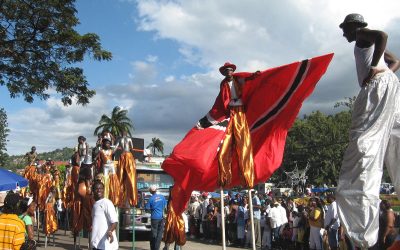
The national flag of Trinidad and Tobago features a unique design with a diagonal stripe and contrasting colours. The black, white, and red of the flag symbolise earth, water, fire, the past, present, and future, and various qualities of the nation and its people. Black represents unity, strength, and purpose; white signifies equality, purity, and the sea that unites the islands, while red represents energy, vitality, and the warmth of the sun.
Cultural melting pot

Jean-Marc /Jo BeLo/Jhon-John from Caracas, Venezuela, CC BY 2.0, via Wikimedia Commons
Trinidad and Tobago’s history of colonisation and immigration has resulted in a rich and diverse cultural landscape. The nation is known for its vibrant festivals, including the world-famous pre-Lenten Carnival, a celebration of music, dance, and costume that attracts visitors from around the world. It is also the birthplace of steelpan, calypso music, and the limbo. The islands’ cuisine reflects the multicultural heritage, blending African, Indian, European, and Chinese influences.
Geography and natural beauty
Trinidad and Tobago’s geography is as diverse as its history. The archipelago consists of two main islands, Trinidad and Tobago, and several smaller islands. Trinidad, the larger of the two, is characterised by three distinct mountain ranges, lush valleys, and fertile plains. Tobago, on the other hand, is mountainous, with a central ridge, deep valleys, and a stunning coastline. The islands boast abundant flora and fauna, with a unique blend of South American and Caribbean species.
Trinidad and Tobago’s history is a tapestry woven with the threads of diverse cultures, resilience, and progress. From its Amerindian origins to the arrival of European colonisers, the legacy of slavery, and the waves of immigration, the nation has embraced its multicultural identity. Today, Trinidad and Tobago stand proudly as an independent republic, celebrating its history, culture, and natural beauty.


Leave a Reply