
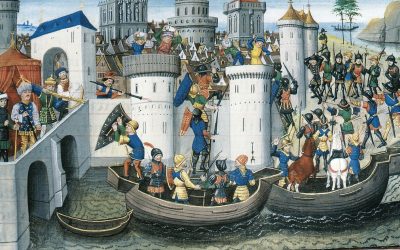
The Crusades stand as one of the most influential periods in the annals of history. They were a series of religious wars that spanned centuries and involved a complex interplay of faith, politics, and ambition. These wars, primarily waged between Christian and Muslim forces, aimed to secure control over sacred lands in the Middle East, most notably Jerusalem. This article delves into the history of the Crusades, exploring their origins, key events, and lasting impacts on both the Christian and Muslim worlds.
Introduction to the Crusades
The Crusades were a series of religious wars sanctioned by the Latin Church in the medieval period, with the primary objective of reclaiming Jerusalem and the Holy Land from Muslim rule. These conflicts had profound socio-economic impacts, facilitated the spread of culture and knowledge, and introduced changes in military technology and tactics. They epitomised the era’s religious fervour and conflict, leading to significant cultural exchanges, economic consequences, and shifts in power dynamics.
Historical background
The backdrop of the Crusades is marked by the rise of Islam and its rapid territorial expansions in the 7th and 8th centuries, which threatened Christian lands. The Byzantine Empire, facing Muslim advances, sought assistance from the West. Emperor Alexios I Komnenos’s appeal to Pope Urban II culminated in the Council of Clermont in 1095. Urban II called for a holy war to reclaim the Holy Land, promising indulgences to those who joined.
The First Crusade (1096-1099)
The First Crusade set the precedent for those that followed. It began with the People’s Crusade, a poorly organised and ill-fated expedition led by Peter the Hermit, which resulted in significant losses. The subsequent Princes’ Crusade, however, saw European nobility leading a successful campaign that culminated in the capture of Jerusalem in 1099, establishing several Crusader states.
The later Crusades
From the Second to the Ninth Crusades, each campaign had its objectives, key battles, and outcomes. The Third Crusade, led by Richard the Lionheart, is notable for its successes and for establishing a truce with Saladin, the Sultan of Egypt and Syria. Conversely, the Fourth Crusade’s diversion to Constantinople, leading to its sack in 1204, marked a significant betrayal of Christian unity. The eventual fall of the last Crusader stronghold in Acre in 1291 signalled the end of the Crusader states.
The Children’s Crusade in 1212, though not officially recognised as one of the major Crusades, was a tragic episode that saw thousands of children embark on a mission to conquer Jerusalem, most of whom never returned.
Impact on Christian and Muslim worlds
The Crusades had lasting impacts on both the Christian and Muslim worlds. Militarily, they led to the development and exchange of techniques and technology. Economically, the Crusader states boosted trade between Europe and the Near East, introducing new goods and ideas to Europe. Culturally, the interaction between Christian and Muslim societies facilitated the transfer of knowledge, including advancements in science, medicine, and philosophy.
Religiously and politically, the Crusades intensified hostilities but also led to diplomatic relationships. They weakened the Byzantine Empire, contributing to its eventual fall and affecting the power of the papacy, with the church experiencing both an increase in authority and later challenges to its power.
Conclusion
The Crusades were a defining series of events that shaped medieval history, leaving a legacy that continues to influence East-West relations. They highlight the power of religious fervour to mobilise societies, the potential for cultural exchange even in times of conflict, and the complexities of Christian-Muslim relations. Through the Crusades, we gain insights into the enduring nature of the human struggle for power, faith, and understanding across different cultures.


Leave a Reply