
Jamaica’s rich and vibrant history has been shaped by the courage, determination, and resilience of its people. With a tapestry of diverse cultures and influences, this Caribbean island nation has evolved from the struggles of its indigenous peoples through the dark days of slavery to the eventual triumph of independence.
Original inhabitants
When looking at Jamaica’s history, we must first consider the first inhabitants. Around 600 CE, a race known as the “Redware people” arrived; little is known of them, however, beyond the red pottery they left. They were followed around 600 AD by the Arawak (also called Taino).
They had migrated from South America some four centuries before Columbus “discovered” Jamaica on 4 May 1494. They named the island Xaymaca, which means “land of wood and water”. The Tainos were a peaceful people with a simple way of life based on fishing, farming, and community living.
The Spanish period
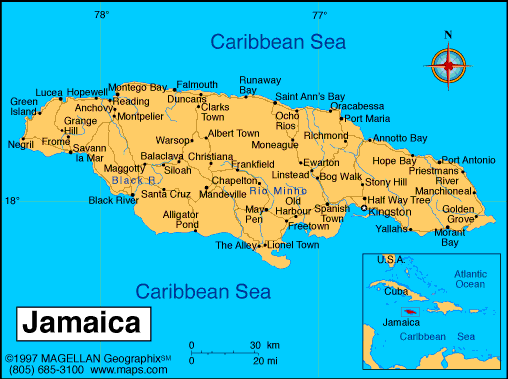
However, the Tainos’ tranquil existence was shattered when European explorer Christopher Columbus arrived in 1494 and claimed the island for Spain. In 1503, he spent a year shipwrecked there. The Spanish crown granted the island to the Columbus family. They did not make much use of the island until 1509 when Juan de Esquivel founded the first permanent European settlement, the town of Sevilla la Nueva (New Seville), what is now St Ann’s Bay on the north coast. In 1534, the capital was moved to Villa de la Vega (later Santiago de la Vega), now called Spanish Town.
Spanish rule lasted for over 150 years, during which time they enslaved the Taino population. The Taino numbers were decimated due to exploitation, forced labour, and the introduction of European diseases to which they had no resistance. The Spanish then began importing African slaves to work on the island’s plantations.
Despite their control, the Spanish failed to develop Jamaica to its full potential, focusing primarily on using the island as a supply base for their conquests in the Americas. Unable to find gold and other precious metals in Jamaica, they saw little use for the island. This period of relative neglect created a power vacuum that would soon be exploited by other European powers, most notably the British.
The British conquest and the rise of Port Royal
In 1655, British naval forces led by Admiral William Penn and General Robert Venables captured Jamaica from the Spanish. The Spanish were forced to surrender, freeing their slaves and fleeing to Cuba. These freed slaves became known as the Maroons, who would play a significant role in Jamaica’s future.
The island was formally transferred to England in 1670 under the provisions of the Treaty of Madrid. With the English came a period of sprawling and prosperous sugarcane plantations and piracy. During the final decades of the 17th century, growing numbers of English immigrants arrived; the sugar, cacao, and other agricultural and forest industries were rapidly expanded, and the consequent demand for plantation labour led to the large-scale importation of black slaves.
Slaves were imported from Africa to work the plantations of wealthy Englishmen, many of whom lived in England, lavishly spending their Jamaican profits. Jamaica soon became one of the principal slave-trading centres in the world.
The British capitalised on Jamaica’s strategic location in the Caribbean to challenge Spanish dominance and disrupt their trade routes. Port Royal, once an insignificant town, quickly became a haven for British privateers and pirates, including the infamous Sir Henry Morgan. The wealth amassed through piracy transformed Port Royal into the “wickedest city in the world” during the 17th century.
However, Port Royal’s fortunes changed dramatically in 1692 when a massive earthquake destroyed much of the city. The survivors relocated to Kingston, which became Jamaica’s capital in 1872. The quake tilted two-thirds of the city into the sea, and a tidal wave swept away the debris and a great deal of valuable loot. Divers have turned up some of the bounties, but much remains in the reefs off Kingston’s shore.
Although the pirates had had their day, the English continued to prosper from Jamaica’s agriculture: Plantations of sugar, tobacco, indigo and eventually bananas thrived on the island. By the 19th century, it was the English Crown’s most profitable Caribbean colony, with a population of about 300,000 African slaves to 20,000 whites. The island also had a population of mulattos–born to white men and slave women–and Maroons, the descendants of freed slaves.
The Maroons and the struggle for freedom
The Maroons, descendants of the freed Spanish slaves, established their own communities in Jamaica’s mountainous interior. They fiercely resisted British attempts to subdue them, embracing guerrilla warfare tactics and exploiting their knowledge of the island’s terrain.
In 1739 and 1740, after two major Maroon Wars, the British signed treaties with the Maroons, granting them land and rights as free men. In return, the Maroons agreed to cease hostilities and assist in recapturing runaway slaves. This agreement, however, caused divisions within the Maroon communities, as not all members agreed to return escaped slaves to the plantations.
Slavery, resistance, and rebellion
As the British expanded their control over Jamaica, the island’s economy became increasingly reliant on the plantation system, with sugar production at its heart. The demand for labour led to an escalation in the African slave trade, with thousands of enslaved Africans arriving in Jamaica to endure brutal conditions on the plantations.
Throughout this period, slaves resisted oppression through acts of defiance and rebellion. Some slaves managed to escape and join the Maroons, while others staged uprisings, such as the 1760 Easter Rebellion led by Tacky and the 1831 Christmas Rebellion led by National Hero Sam Sharpe.
These acts of resistance, combined with growing opposition to slavery from humanitarian groups in Britain, eventually led to the Slave Trade Act calling for the abolition of the slave trade in 1807 and the emancipation of slaves in 1838.
The British Parliament abolished slavery on 1 August 1834. The act made available $30 million as compensation to the owners of the nearly 310,000 liberated slaves. Without slave labour, however, the sugarcane plantations were no longer so profitable, and it seemed their time had also passed. Competition and falling prices took a further toll on Jamaica’s sugar production reign.
Post-emancipation challenges and the Morant Bay Rebellion
Large numbers of the freed blacks abandoned the plantations following emancipation and took possession of unoccupied lands in the interior, gravely disrupting the economy. Labour shortages, bankrupt plantations, and declining trade resulted in a protracted economic crisis. Oppressive taxation, discriminatory acts by the courts, and land-exclusion measures ultimately caused widespread unrest among blacks. The freed slaves suffered economic hardship, and a drought in 1865 brought on desperate times.
In 1865, the Morant Bay Rebellion led by Paul Bogle erupted, with protestors storming the Morant Bay Courthouse and killing several white officials. The British authorities responded with brutal force, executing hundreds of people and destroying thousands of homes. This event marked a turning point in Jamaica’s history, leading to the introduction of the Crown Colony system of government, which centralised power in the hands of the British governor.
Jamaica’s becoming a crown colony meant losing the large degree of self-government it had enjoyed since the late 17th century. Due to the strife, the Jamaican Assembly relinquished much of its power to the governor, and in 1866, Jamaica became an official Crown Colony. Representative government was partly restored in 1884. After a long period of direct British colonial rule, Jamaica gained a degree of local political control in the late 1930s and held its first election under full universal adult suffrage in 1944.
Continue reading Jamaica and the path to independence.


Leave a Reply