
Where is the Gambia?
The Republic of The Gambia is the smallest country within mainland Africa and is sandwiched by Senegal. Banjul is the capital and the largest city in the Gambia.
The Gambia has long been home to several different ethnic groups who have maintained their individual cultural traditions; as such, the country has a rich heritage.
You can watch the video or read on.
What are the people of the Gambia like?
The population is mainly Muslim. There are a small number of Christians, predominantly Roman Catholic and some adherents of traditional beliefs.
Gambian cuisine is nearly identical to Senegalese cooking. Staples include millet, rice, yams, plantains, and cassava. Fish, both dried and fresh, as well as sauces made from fish and peanuts dominate the diet throughout the country. Millet and rice porridges are often served as breakfast.
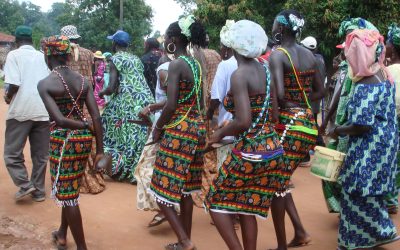
Gambians, especially those in Banjul and upcountry towns, wear both traditional West African clothing as well as European-style dress. Gambian women often wear elaborate head wraps and flowing caftans. Men typically wear traditional shirts and Western pants, but on Fridays and Muslim holidays, they wear traditional Arab dress and skullcaps, especially when going to the mosque.
The peculiar shape and size of the country are the result of territorial compromises made during the nineteenth century by Great Britain, which controlled the lower Gambia River, and France, which ruled the neighbouring colony of Senegal.
How did the Gambia break away from British rule? Let’s go back in time to the beginning.
Religious wars
Gambian history before the arrival of Europeans has been preserved to some degree in oral traditions. Its history is closely tied to that of neighbouring Senegal since it was only in the late nineteenth century that a distinction was made between Senegal and The Gambia; until that time, the region is often referred to as Senegambia.
The Malinke and Wolof kingdoms, fully established by the 19th century, were still in the formative stages when the Venetian explorer Alvise Ca’ da Mosto, in the service of Portugal’s Prince Henry the Navigator, arrived in 1455. The Portuguese set up trading stations but abandoned them within a century. Trade possibilities brought the English, French, Swedish and Dutch trading companies to Western Africa.
Although locally powerful, none of the small Gambian kingdoms was ever strong enough to dominate Senegambia. Continuing internal warfare made it easy for the French and British to dominate the territory.
The Soninke-Marabout Wars began in The Gambia in the 1850s until 1901. It was basically a civil war among the Mandinka tribe, which erupted on both the north and south banks of the river.

A marabout is a Muslim religious leader and teacher in West Africa. The Marabouts were holy Islamic clerics and teachers, and the Soninke were Mandinka kings.
The Marabouts, in addition to their sacred functions, were also merchants and physicians and were distinguished by their red, yellow, or blue caps. Some of them were school teachers, while others were missionaries or, like their European brethren, followed in the train of nobles and kings.
The wars were caused partly by the persistent adherence of the Soninkes and their people to local traditional religions in the form of animism, lax religious practices combined with a taste for alcohol at the same time as adhering to Islam. Most of the wars were in fact, battles and skirmishes but displaced large numbers of people in The Gambia.
Islam was brought to the peoples of Senegambia by North African traders in the 11th century. These Marabouts would marry local women, thus creating Muslim families in communities that still held onto the beliefs of the traditional animist religion.
When was the Gambia colonised?
Throughout the 18th century, there was a struggle for prestige in Senegambia between France and England. This changed in 1816 when Captain Alexander Grant was sent to the region to re-establish a base from which the British Navy could control the slave trade. He purchased Banjul Island from the king of Kombo and renamed it Saint Mary’s Island. There, he built barracks, laid out a town called Bathurst, and set up an armed force to control access to the river. Bathurst grew rapidly with the arrival of traders and workers from Gorée and upriver.
The Gambia was managed as a part of British West Africa from 1821 to 1843. It was a separate colony with its own governor until 1866, when control was returned to the governor-general at Freetown, Sierra Leone, as it would remain until 1889.
British domination of the riverbank areas seemed certain after 1857, but the increasing importance of peanut cultivation in Senegal prompted new imperialism. By 1880, France controlled Senegal; in the 1870s, the British attempted twice to trade the Gambia to France, but opposition at home and in the Gambia blocked these plans. The Soninke-Marabout Wars complicated matters. Only one Muslim leader, Maba, emerged who could have unified the various kingdoms, but he was killed in 1864.
By 1880, the religious aspect of the wars had virtually disappeared, but war chiefs such as Musa Mollah, Fodi Silla, and Fodi Kabba continued the conflicts.
When did the Gambia become independent?
Following a conference in Paris in 1889, France relinquished control of the Gambia River to Britain, and the present-day boundaries of the Gambia were drawn. In 1900, Britain imposed an indirect rule on the protectorate, dividing it into 35 chiefdoms, each with its own chief. The real power was concentrated in the British governor and his staff at Bathurst.
Slavery was abolished throughout the protectorate in 1906. During World War Two, the Gambia contributed soldiers for the Burmese campaign and was used as an air-staging post.
Political parties were late in developing, but by 1960, there were parties demanding independence. Britain, believing that eventually the Gambia would merge with Senegal, granted the country internal self-governance in 1963.
On 18 February 1965, the Gambia gained independence under the leadership of Dawda Jawara.


Leave a Reply