• Skip to main content
  • Skip to after header navigation
  • Skip to site footer
Our history archive

Our History

Our History Archive, where history comes to life

  • Home
  • Colonisation
  • World History
  • Civil Rights
  • World cultures
  • Features
  • Wellbeing
  • Popular Culture

The Gadsden Purchase: America’s quest for a southern railroad

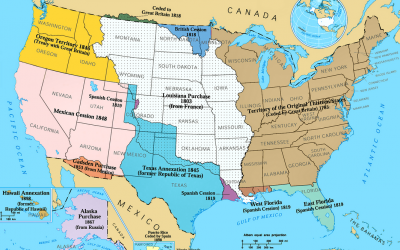
Gadsden Purchase
Territorial enlargement of the United States, the Gadsden Purchase shown in red-orange (United States federal government (en:User:pink and White converted it from JPEG to PNG and retouched it), Public domain, via Wikimedia Commons)
World history
3 April, 2020

In the tapestry of American expansion, the Gadsden Purchase of 1853 stands out as a significant but often overlooked chapter. Named after James Gadsden, the US diplomat who negotiated the deal, this purchase added approximately 29,670 square miles of land from Mexico to the United States. This acquisition, small compared to the Louisiana Purchase or the acquisition of Texas, was pivotal in shaping the United States’s southern boundary and fulfilling the nation’s transcontinental ambitions.

Background: Manifest Destiny and the need for a Southern route

A fervent belief in Manifest Destiny marked the early 19th century in America—the idea that the United States was destined to expand across the North American continent. Following the Mexican-American War (1846-1848) and the subsequent Treaty of Guadalupe Hidalgo, the US acquired vast territories in the west. However, the need for a practical southern transcontinental railroad route became increasingly evident, particularly one that would avoid the difficult mountain terrains of the North and the harsh desert conditions of the Southwest.

James Gadsden and diplomatic negotiations

Lieutenant James Gadsden, U.S. Army, later American ambassador/ minister to Mexico
(After Charles Fraser, Public domain, via Wikimedia Commons)


James Gadsden, appointed US Minister to Mexico in 1853, was tasked with negotiating with the Mexican government. Gadsden, a former military officer and a railroad executive understood the strategic importance of a southern transcontinental route. His mandate was to acquire a tract of land south of the Gila River, which was part of the Mexican territory following the Treaty of Guadalupe Hidalgo.

Mexico’s reluctance and the final agreement

President and General Antonio López de Santa Anna, photo circa 1853
By Meade Brothers – SMU Digital Collections, Public Domain, Link

Having lost almost half of its territory in the recent war with the US, Mexico was initially reluctant to sell more land. However, the country was also in financial distress and dealing with internal political turmoil. 

Mexican President Antonio López de Santa Anna eventually agreed to sell the land for $10 million, a price that was significantly less than what the US had paid for the Louisiana Purchase or the lands acquired after the Mexican-American War.

The land acquisition and its significance

The Gadsden Purchase, signed on 30 December 1853 and ratified in 1854, provided the United States with the land necessary for a southern railroad route. The purchase included parts of what are now southern Arizona and New Mexico. This territory was mostly desert, but its acquisition was crucial for constructing the southern transcontinental railroad, which would eventually link the eastern and western coasts of the country.

Controversy and impact on the Civil War

The Gadsden Purchase was not without controversy. Debates over whether the new territories would be free or slave-holding exacerbated the sectional tensions between the North and the South. This conflict over slavery in the new territories would contribute to the onset of the Civil War.


Long-term implications

Gadsden Purchase
Territorial enlargement of the United States, the Gadsden Purchase shown in red-orange (United States federal government, Public domain, via Wikimedia Commons)

Beyond its immediate impact on transportation and sectional tensions, the Gadsden Purchase also had long-term implications for US-Mexico relations and the development of the American Southwest. It finalised the contiguous boundaries of the continental United States and opened up new areas for exploration, settlement, and economic development. The railroad, completed after the Civil War, played a crucial role in the economic growth of the region.

Conclusion

The Gadsden Purchase, while a smaller and less-discussed acquisition compared to other territorial expansions of the United States, was a critical move in the nation’s westward expansion and in fulfilling its transcontinental dream. It represents a significant moment in US history, where diplomacy, economic ambitions, and the ideologies of Manifest Destiny converged to shape the nation’s geographical and historical landscape.

Share this:

  • Share on Facebook (Opens in new window) Facebook
  • Share on X (Opens in new window) X
  • Share on Reddit (Opens in new window) Reddit
  • Share on Pinterest (Opens in new window) Pinterest
  • Share on WhatsApp (Opens in new window) WhatsApp

Related

You May Also Like…

More details Merida - Palacio de Gobierno - Murals by Fernando Castro Pacheco: The Spanish bishop Diego de Landa is burning figures of Mayan deities

The forgotten fire: A history of the Darfur Genocide

The Japanese occupation of Beiping (Beijing) in China

The rise and fall of the Japanese Empire

Rescuers and residents searching the rubble of the destroyed Shajareh Tayyebeh elementary school in Minab

The fracturing of the international order in an age of impunity

US ambassador to the UN, Eleanor Roosevelt, holding the Universal Declaration of Human Rights in 1949

The role and limitations of international law in world affairs


Reader Interactions

Leave a ReplyCancel reply

Sidebar

This Day In History

No Events

World history recent posts in

More details Merida - Palacio de Gobierno - Murals by Fernando Castro Pacheco: The Spanish bishop Diego de Landa is burning figures of Mayan deities

The forgotten fire: A history of the Darfur Genocide

The Japanese occupation of Beiping (Beijing) in China

The rise and fall of the Japanese Empire

Rescuers and residents searching the rubble of the destroyed Shajareh Tayyebeh elementary school in Minab

The fracturing of the international order in an age of impunity

US ambassador to the UN, Eleanor Roosevelt, holding the Universal Declaration of Human Rights in 1949

The role and limitations of international law in world affairs

Trending

  • The rise and fall of the Persian Empire
    The rise and fall of the Persian Empire
  • Mexican culture: A living mosaic of civilisations, faith, and tradition
    Mexican culture: A living mosaic of civilisations, faith, and tradition
  • The British Empire: An overview of empire and colonisation
    The British Empire: An overview of empire and colonisation
  • The 1972 Munich Olympics massacre
    The 1972 Munich Olympics massacre
  • The history of South Africa: From colonisation to independence
    The history of South Africa: From colonisation to independence
  • Operation Ajax and the shadow of empire: The 1953 Iranian coup
    Operation Ajax and the shadow of empire: The 1953 Iranian coup
  • History of Canada - From colonisation to independence
    History of Canada - From colonisation to independence
  • Holy Wars: The blood-soaked legacy of conflicts fought in the name of Christianity
    Holy Wars: The blood-soaked legacy of conflicts fought in the name of Christianity
  • The forgotten fire: A history of the Darfur Genocide
    The forgotten fire: A history of the Darfur Genocide
  • The Arab slave trade
    The Arab slave trade

Connect

  • YouTube
  • TikTok
  • Bluesky

ABOUT

CONTACT

PRIVACY POLICY

COOKIES

Copyright © 2026 · Our History · All Rights Reserved