• Skip to main content
  • Skip to after header navigation
  • Skip to site footer
Our history archive

Our History

Our History Archive, where history comes to life

  • Home
  • Colonisation
  • World History
  • Civil Rights
  • World cultures
  • Features
  • Wellbeing
  • Popular Culture

Origins of Black Friday and other lies told to us

Features
29 November, 2014

In this post we fact check the origins of Black Friday and the Willie Lynch speech.

Toni Braxton posted a call to boycott Black Friday on her Facebook page with an image of a slave auction and text claiming that Black Friday was linked to slave auctions the day after Thanksgiving. This post did the rounds on Facebook and Twitter helping to miseducate generations of Black people. Celebs have the power to do so much good if only they would educate themselves first.
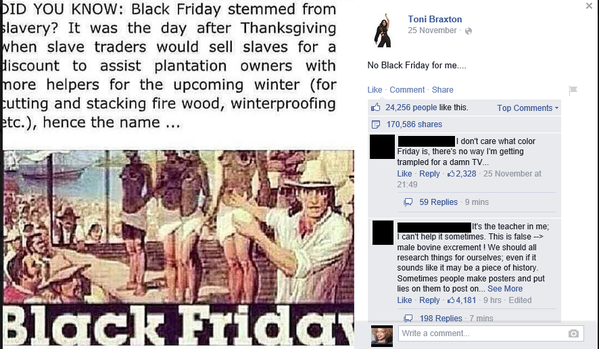
black-friday-toni-braxton-facebook


This claim is false. The origins of Black Friday have nothing to do with slavery. The term was first coined in 1951 to refer to the practice of workers calling in sick on the day after Thanksgiving in order to have four consecutive days off.

By 1961 the term “Black Friday” was being used mockingly by Philadelphia police, who had to deal with the mayhem caused by all the extra pedestrian and vehicular traffic created by hordes of shoppers heading to the stores on the two days after Thanksgiving.

Eventually, the term was claimed by retailers to refer to the fact that the day after Thanksgiving was a chance for their accounts to be ‘in the black’ as the Christmas holiday shopping began.

Someone deliberately created that image to get a rise out of Black folks and it wasn’t Toni. It is hard to understand why someone would want to tell lies about something like this until you look at other things designed to trigger black anger.

You may have heard the saying “the best way to hide something from Black people is to put it in a book.” Whilst nobody knows for sure where the saying came from we can all agree that it is designed to serve up negative emotions and possible debate.


The Willie Lynch speech

When it comes to negative emotions, can there be anything more debated than the Willie Lynch speech? This is supposed to be a speech given by one William Lynch to slave owners. In this speech, he reveals the secret of controlling slaves by setting them against each other. Despite the infamous speech being proven as a hoax, Black people still debate its merits. There are many who know (and admit) that the “speech” is fake but they want to “wake up” Black people.

In other words, they consciously lie to Black people when it is convenient.

Why do people knowingly share lies on social media: Likes, shares and retweets seem to be a factor but Black anger for sport could be another. A lot of so-called racist posts are actually created by black people so it pays to be cautious. One person shared a story of a black boy being killed by police just to see how many people would retweet it without fact-checking. It got thousands of retweets.

The way we get our news has changed a lot. It pays to check facts before sharing. We like to call people out on their racist behaviour but we should make sure to call each other out on our bullshit lies and shit-stirring too. Another tale doing the rounds is the meaning of the word picnic.


See also: 12 Reasons to Stop Promoting the Fake “Willie Lynch” Speech

Share this:

  • Share on Facebook (Opens in new window) Facebook
  • Share on X (Opens in new window) X
  • Share on Reddit (Opens in new window) Reddit
  • Share on Pinterest (Opens in new window) Pinterest
  • Share on WhatsApp (Opens in new window) WhatsApp

Related

You May Also Like…

More details Jesse Jackson surrounded by marchers carrying signs advocating support for the Hawkins-Humphrey Bill for full employment,

Keep hope alive: The rise, power, and legacy of Jesse Jackson

The revolutionary icon: Ernesto "Che" Guevara

Ernesto “Che” Guevara: : The revolutionary icon

Portrait of Bartolomé de Las Casas (c.1484 - 1566)

Bartolomé de las Casas and the birth of human rights

William Randolph Hearst

William Randolph Hearst: The king of Yellow Journalism


Reader Interactions

Leave a ReplyCancel reply

Sidebar

This Day In History

No Events

More details Jesse Jackson surrounded by marchers carrying signs advocating support for the Hawkins-Humphrey Bill for full employment,

Keep hope alive: The rise, power, and legacy of Jesse Jackson

The revolutionary icon: Ernesto "Che" Guevara

Ernesto “Che” Guevara: : The revolutionary icon

Portrait of Bartolomé de Las Casas (c.1484 - 1566)

Bartolomé de las Casas and the birth of human rights

Trending

  • The rise and fall of the Persian Empire
    The rise and fall of the Persian Empire
  • History of Canada - From colonisation to independence
    History of Canada - From colonisation to independence
  • Mexican culture: A living mosaic of civilisations, faith, and tradition
    Mexican culture: A living mosaic of civilisations, faith, and tradition
  • Operation Ajax and the shadow of empire: The 1953 Iranian coup
    Operation Ajax and the shadow of empire: The 1953 Iranian coup
  • The forgotten fire: A history of the Darfur Genocide
    The forgotten fire: A history of the Darfur Genocide
  • The life and legacy of Louise Bennett: A Jamaican poet whose words still resonate
    The life and legacy of Louise Bennett: A Jamaican poet whose words still resonate
  • The history of South Africa: From colonisation to independence
    The history of South Africa: From colonisation to independence
  • The rise and fall of the Ottoman Empire: Six centuries of imperial power
    The rise and fall of the Ottoman Empire: Six centuries of imperial power
  • European colonisation of Southeast Asia
    European colonisation of Southeast Asia
  • History of the Chagos Islands: A tale of colonialism
    History of the Chagos Islands: A tale of colonialism

Connect

  • YouTube
  • TikTok
  • Bluesky

ABOUT

CONTACT

PRIVACY POLICY

COOKIES

Copyright © 2026 · Our History · All Rights Reserved