
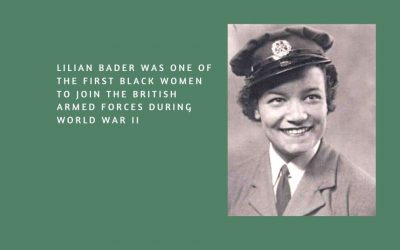
Lilian Bader was born in 1918 in Liverpool’s Toxteth Park neighbourhood to Marcus Bailey, a merchant seaman from Barbados who fought for the British in the First World War, and Lilian, a British woman whose parents were Irish. The Baileys were married in 1913, and Bader was their youngest child.
Bader and her older brothers, Frank and James, were orphaned in 1927. She was raised in a convent and remained there until she was 20 because no one would hire her. Despite this, she was determined to overcome racial prejudice.
She found employment in domestic service. When war broke out in 1939, Lilian wanted to do her bit for the war effort. She found a job in a NAAFI canteen, serving food and drink to servicemen, but after seven weeks, she was asked to leave as her father hadn’t been born in the UK. In other words, she was dismissed because of the ‘colour bar’. After avoiding informing her of this decision for weeks, her supervisor eventually had to tell her the truth and let her go.
When she returned to domestic service, Bader felt embarrassed when soldiers she befriended expressed surprise that she wasn’t doing war work: “How could I tell them that a coloured Briton was not acceptable, even in the humble NAAFI?”
On 28 March 1941, Bader enlisted with the Women’s Auxiliary Air Force (WAAF) after hearing that the RAF was accepting recruits with West Indian backgrounds. She was “the only coloured person in this sea of white faces”, but, “somebody told me I looked smart in my uniform, which cheered me no end.”

Bader’s joy at being enlisted in the WAAF was overshadowed by tragedy. Just two weeks before enlisting, her brother, Able Seaman James Bailey, was killed in action while serving in the Merchant Navy. In Ray Costello’s Black Liverpool – The Early History of Britain’s Oldest Black Community 1730-1918 (2001), Bader said: “I hoped against hope that he had been picked up as I knew he sailed in convoy. The survivors of his ship, the Western Chief, were picked up, but Jim was not amongst them.”
In the WAAF, Bader took an exam and was accepted onto a course for instrument repairers, becoming one of the first group of women to be allowed on to planes to check for leaks in their vital pipes. The WAAF uniform skirt wasn’t exactly suitable for clambering around inside twin-engined light bombers. Lilian’s group were the first women in the WAAF to be issued more practical overalls and battle dress. On passing the course in December 1941, Lilian became an Aircraftwoman First Class (with her pay doubled from twenty-two shillings a fortnight to forty-four). By the time she left the service, she had been promoted to Acting Corporal.
Through an ex-landlady in Yorkshire, Lilian made contact with a young British-born black soldier called Ramsay Bader. He was a tank driver serving with the 147th (Essex Yeomanry) Field Regiment, Royal Artillery. Lilian and Ramsay exchanged letters and photographs. Until then, Bader had rarely encountered other black people, especially in the forces, and she immediately felt attracted to Ramsay: “Even in the ugly khaki battle dress, he looked like an officer. However, I remembered the old adage, ‘good looking nowt,’ and reserved judgement.”
Nevertheless, the pair were married in 1943 in Hull. Bader’s chances of further promotion in the WAAF were impacted when she discovered she was expecting a baby. She received her discharge in February 1944.

On 6 June 1944, Ramsay was one of the thousands of soldiers engaged in the D-Day landings. It was an anxious time for Bader. Interviewed on Radio 2’s The Forgotten Volunteers (11 November 2000), she recalled: “I didn’t know if Ramsay was alive or dead… I remember kneeling in the chapel and praying like blazes that Ramsay would be saved. It was a terrible time because you knew some people were going to be killed, and Ramsay couldn’t swim! He hated water. That’s what worried me more than anything, but he came through.”
The couple had two sons, and when they had grown up, Bader studied for a Bachelor of Arts degree at London University and became a teacher. After retiring, she continued teaching private pupils and U3A classes well into her eighties.
In 1989, Bader’s memoir, Together – Lilian Bader: Wartime Memoirs of a WAAF 1939-1944, was published.
All her life Lilian fought hard against racism and prejudice, often writing letters to the media and politicians. She told her story – and the stories of six other members of her family of African descent who had fought for Britain during two world wars – to the Imperial War Museum and journalists and appeared on several television programmes. She was determined that the contribution made by Black and Asian Britons to the country’s defence should be recognised and remembered, so it is fitting that she was invited to meet the Queen at the inauguration of the Commonwealth Memorial Gates in Hyde Park in 2002.
Lilian Bader died on 14 March 2015, aged 97.


Leave a Reply