
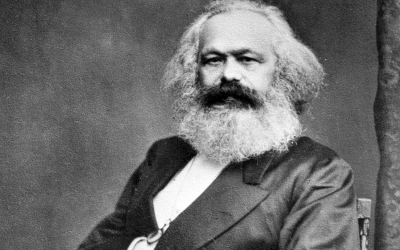
Karl Marx (1818-1883) is recognised as one of the most influential thinkers and philosophers of all time. Born in Trier, Germany, Marx’s ideas would go on to shape the social, economic, and political landscape for generations to come. He is best known for his revolutionary ideas on socialism and communism, which would later form the basis of Marxism—a social, political, and economic theory centred around class struggle.
Early life and education
Karl Marx was born on 5 May 1818, to a relatively well-off middle-class family. His father, Heinrich Marx, was an attorney who had converted to Lutheranism to escape antisemitism. As a result, young Karl was baptised at six years old. He began his formal education at Trier Gymnasium (high school), where he was introduced to classical literature and philosophy.
Marx later attended the University of Bonn to study law but became more interested in philosophy. After a brief period of drinking and other extracurricular activities, Marx transferred to the University of Berlin to study under G.W.F. Hegel—a prominent German philosopher known for his dialectical thinking.
Introduction to radical thought
Marx’s interest in radical thought was ignited during his time at the University of Berlin. Here, he became involved with various radical groups advocating for social change, including the Young Hegelians—a group of students who applied Hegelian thought to critique existing institutions like organised religion and politics.
In 1841, Karl Marx received his Doctor of Philosophy degree from Jena University after writing an extensive dissertation on ancient Greek natural philosophers. Despite this achievement, his radical affiliations made it difficult for him to find employment within academia.
Journalistic work and collaboration with Engels

Marx turned to journalism to express his ideas and generate income. He eventually became the editor of Rheinische Zeitung, a liberal newspaper in Cologne, in 1842 but was forced to resign due to state censorship and political pressure.
In 1844, Marx met Friedrich Engels in Paris, and their collaboration turned into a lifelong friendship. Engels was the son of a wealthy factory owner and had firsthand experience of class struggle. United by shared beliefs on economic inequality and social justice, the pair began working together on various texts.
Das Kapital and The Communist Manifesto
Karl Marx’s most famous works include Das Kapital (Capital: A Critique of Political Economy) and The Communist Manifesto. In Das Kapital, Marx examined the inner workings of capitalism and proposed that it would ultimately lead to its own downfall due to inherent contradictions. Written during his years of exile in London, Das Kapital is considered a foundational text in Marxist thought.
In 1848, with Engels as co-author, Marx published The Communist Manifesto. The pamphlet called for the overthrow of capitalism by the proletariat—the working class—and the establishment of a socialist society where property and wealth would be shared among all citizens.
Impact and legacy
Marx’s monumental impact on society is undeniable. His ideas have shaped countless political movements, including those that led to the formation of socialist and communist governments around the world.
However, it is important to note that Marxist theory has evolved since his death, formulated by later thinkers into different branches such as Leninism, Maoism, Trotskyism, and more. While some argue that these evolutions have strayed from Marx’s original intent, there is no denying the significance and influence of his revolutionary thought.
Karl Marx passed away in London on 14 March 1883. His contributions to social theory continue to reverberate to this day. His daughter, Eleanor Marx, became a well-known feminist and socialist campaigner in her own right.


Leave a Reply