
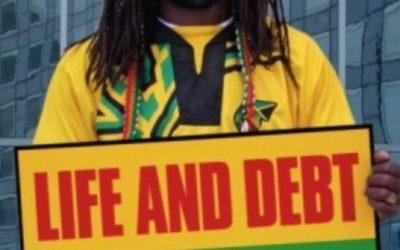
For over 40 years the people of Jamaica have suffered under the weight of massive debt. Jamaica is one of the most indebted countries and spends twice as much on debt repayments as it does on education and health combined.
In 1972 Prime Minister Michael Manley instituted wide-ranging socialist reforms. The resulting trade deficit brought Jamaica near bankruptcy by 1980.

Conditions imposed with loans mean that foreign institutions such as the International Monetary Fund (IMF) dictate policies and spending within Jamaica. The conditions usually require cutting of public services resulting in increases in inequality and poverty. Jamaica has a population of approximately 2.7 million of which 1.1 million are living below the poverty line.
Since 1990 the economy has almost stopped growing.
Here are 6 facts you should know about Jamaica’s debt

- The 1970s oil crisis knocked the wind out of the global economy and helped trigger a stock market crash. As an importer of oil, Jamaica was hit hard. In the 1973 recession, devaluation due to the high oil price and the need to borrow to purchase vital imports rapidly increased the government’s foreign debt.
- Jamaica’s first loan agreement with the IMF came in 1977 due to a lack of viable alternatives. When US dollar interest rates rose at the start of the 1980s, debt payments shot up; from 16 per cent of government revenue in 1977 to 40 per cent by 1984. Foreign debt payments have remained above 20 per cent of government revenue ever since.
- Jamaica was never considered eligible for the Heavily Indebted Poor Countries (HIPC) Initiative. The HIPC Initiative is the first international response to provide comprehensive debt relief to the world’s poorest, most heavily indebted countries but with a GDP per person of around $6,500 (£4,000) Jamaica is considered an upper-middle-income country, and so far ‘too rich’ for debt relief.
- Maternal mortality in Jamaica has increased throughout the period of debt crisis and austerity. In 1990, 59 mothers died for every 100, 000 births. By 2010, this had almost doubled to 110. In the UK, the maternal mortality rate is 12 deaths for every 100,000 births.
- At present Jamaica owes over $4.5 billion to the IMF, the World Bank and the Inter-American Development Bank (IADB) among other international lending agencies yet the meaningful development that these loans have “promised” has yet to manifest. In actuality, the amount of foreign exchange that must be generated to meet interest payments and the structural adjustment policies which have been imposed with the loans have had a negative impact on the lives of the vast majority.
- Jamaica’s total debt as of March 31 2015 stood at $1.85 trillion JMD (185 billion US Dollars or around £130bn), $801.5 billion JMD of which represents external debt. The country’s internal debt is $1.05 trillion JMD.
Find out more about Jamaica’s debt
Read: The Multilateral Debt Trap in Jamaica
Watch: The documentary Life and Debt reveals Jamaica’s long struggle to overcome the struggling developing economy and the debt burden under an IMF loan. It details the crippling conditions under the loan that forced it to import food, adjust agriculture to global preferences while out pricing Jamaica farmers, creating factory jobs with sweatshop conditions and even importing cheap Chinese labour to the island’s semi-autonomous “Free Trade Zone.”
The effects of this crushing debt and its draconian influence over development has stunted opportunity for ordinary people in Jamaica for decades to come.


Leave a Reply