• Skip to main content
  • Skip to after header navigation
  • Skip to site footer
Our history archive

Our History

Documenting world history and civil rights

General

  • About
  • Cookies and your privacy
  • Privacy policy
  • Contact

Categories

  • Home
  • Colonisation
  • World History
  • Civil Rights
  • World cultures
  • Features
  • Wellbeing
  • Popular Culture
  • Home
  • Colonisation
  • World History
  • Civil Rights
  • World cultures
  • Features
  • Wellbeing
  • Popular Culture

How Haiti won its independence

How Haiti won its independence
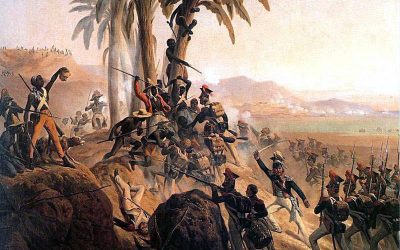
January Suchodolski, Public domain, via Wikimedia Commons
Colonisation
1 January, 2021

On 5 December 1492, European navigator Christopher Columbus came upon an island in the Caribbean that he claimed for Spain and called La Isla Española (“The Spanish Island”, later Anglicised as Hispaniola).

Haiti colonised by Spain

Spain colonised the island and enslaved the native Taino and Ciboney people. Forced to mine gold under brutal working conditions and overcome by European diseases, the native population almost vanished by the end of the 16th century. Thousands of slaves imported from other Caribbean islands met the same fate.

French rule

After the Spanish exhausted the main gold mines, the French established their own permanent settlements and renamed the colony Saint-Domingue. The Spanish kept the eastern part of the island, which they named Santa Domingo (present-day Dominican Republic).


Under French rule, Saint-Domingue grew to be the wealthiest colony in the French empire and, perhaps, the richest colony in the world, producing roughly 40 per cent of the sugar and 60 per cent of the coffee imported to Europe.

To supply the plantation system, French owners imported almost 800,000 Africans to Saint-Domingue. The slave system in the colony was regarded as one of the harshest in the Americas, as French slave owners worked Africans brutally. Mortality rates were extremely high.

Haitian revolution and freedom

Inspired by the French Revolution, the enslaved and free people of Saint-Domingue rose up against France. This successful and complicated campaign for freedom and equality began in 1791.

How Haiti won its independence
January Suchodolski, Public domain, via Wikimedia Commons

Led by former slave Toussaint Louverture, the enslaved acted first, rebelling against the planters on 21 August 1791. By 1792, they controlled a third of the island. Despite reinforcements from France, the area of the colony held by the rebels grew, as did the violence on both sides. Before the fighting ended, 100,000 of the 500,000 blacks and 24,000 of the 40,000 whites were killed.

By 1801, Louverture expanded the revolution beyond Saint-Domingue, conquering the neighbouring Spanish colony of Santo Domingo. He abolished slavery in the Spanish-speaking colony and declared himself Governor-General for life over the entire island of Hispaniola.


Napoleon Bonaparte, now the ruler of France, dispatched General Charles Leclerc, his brother-in-law, and 43,000 French troops to capture Louverture and restore both French rule and slavery. Louverture was captured and sent to France, where he died in prison in 1803.

Independence

Jean-Jacques Dessalines, a former slave and one of Louverture’s generals, led the revolutionaries at the Battle of Vertieres on 18 November 1803, where the French forces were defeated. On 1 January 1804, Dessalines declared the nation independent and renamed it Haiti.

France did not recognise Haiti’s independence until 1825, and then only in exchange for a large compensation of 150 million francs. This debt took Haiti 122 years to pay off.

Share this:

  • Share on Facebook (Opens in new window) Facebook
  • Share on X (Opens in new window) X
  • Share on Reddit (Opens in new window) Reddit
  • Share on Pinterest (Opens in new window) Pinterest
  • Share on WhatsApp (Opens in new window) WhatsApp


Related

You May Also Like…

Statues of the rules of Kush now modern day Sudan

Sudan: From ancient kingdoms to independence

Monument to 1795 Slave Revolt, Curaçao

The 1795 slave revolt of Curaçao

The History of Curaçao

The History of Curaçao

History of Chad

The history of the Republic of Chad: From pre-colonisation to independence


Reader Interactions

Leave a ReplyCancel reply

Sidebar

This Day In History

Events in History
On this day in 1990 Nelson Mandela, who was the leader of the movement to end South African apartheid was released from prison after 27 years.

World history recent posts in

Rwanda genocide

Ten dark moments in colonial history

The First Anglo-Afghan War

The First Anglo-Afghan War (1839-1842): Britain’s imperial disaster in the Hindu Kush

Operation Ajax the 1953 Iranian coup

Operation Ajax and the shadow of empire: The 1953 Iranian coup

The Great Game- 1920s bird's eye map depicting the approaches to British India through Afghanistan, including then Soviet territory

The Great Game: Britain and Russia’s strategic rivalry in Central Asia

Trending

  • Understanding Sharia Law: Principles, practice, and global context
    Understanding Sharia Law: Principles, practice, and global context
  • Genghis Khan: The making of the Mongol Empire
    Genghis Khan: The making of the Mongol Empire
  • Pancake Day: A tradition of faith and feasting
    Pancake Day: A tradition of faith and feasting
  • This John Hanson was not the first Black President of the United States
    This John Hanson was not the first Black President of the United States
  • McCarthyism and the Cold War: America's Second Red Scare
    McCarthyism and the Cold War: America's Second Red Scare
  • What are British values?
    What are British values?
  • Women's suffrage movement in Britain
    Women's suffrage movement in Britain
  • Five countries that colonised the world
    Five countries that colonised the world
  • The rise and fall of the Ottoman Empire: Six centuries of imperial power
    The rise and fall of the Ottoman Empire: Six centuries of imperial power
  • Spanish colonisation: Overview of the Spanish Empire's expansion and impact
    Spanish colonisation: Overview of the Spanish Empire's expansion and impact

Connect

  • YouTube
  • TikTok
  • Bluesky
  • About
  • Cookies and your privacy
  • Privacy policy
  • Contact

Copyright © 2026 · Our History · All Rights Reserved