
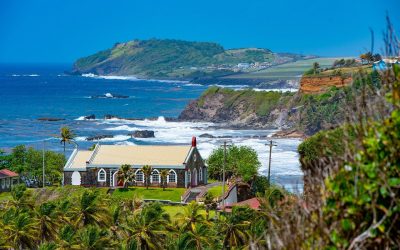
Saint Vincent and the Grenadines, a picturesque Caribbean nation, holds a rich history that dates back centuries. From the indigenous tribes to European colonisation and the struggles for independence, this article takes you on a captivating journey through time. Discover the fascinating stories of the Ciboney, Arawak, Carib, Garifuna and the impact of British rule on the island.
Pre-European contact: Indigenous tribes
Long before European explorers set foot on Saint Vincent, the island was inhabited by the Ciboney, an indigenous tribe. They were later joined by the Arawak people, who migrated from Venezuela and settled in the West Indies. However, the Arawaks were eventually displaced by the Caribs, another indigenous group originating from South America.
European contact and colonial influence
Contrary to popular belief, Christopher Columbus did not visit Saint Vincent in 1498 as previously thought. In fact, there is no evidence to suggest that he ever set foot on the island. The first European attempts to settle on the island were made by the French in the early 18th century. The Caribs, seeking French support against the English, allowed limited French settlement on the island’s west coast. However, in 1763, under the Treaty of Paris, Saint Vincent came under British control. This marked the beginning of a tumultuous period in the island’s history.
Conflict and exile: Wars with the Caribs
The Caribs, fiercely resisting British presence, engaged in two wars with the colonial powers. The first war occurred from 1772 to 1773, followed by a second conflict from 1795 to 1796. The Caribs were eventually exiled following their defeat in the second war. Most of them were deported to an island off the coast of Honduras. From there, they later migrated to Belize and other regions along the Atlantic coast of Central America. The Caribs who remained took sanctuary in the interior of the island. An act of the colonial legislature in 1805 pardoned them for their rebellion.
British control and the plantation economy
With the conquest of the Caribs, the British government took complete control of Saint Vincent. The island became part of the administrative union known as the Windward Islands, along with Grenada, Dominica, Tobago, and the Grenadines. A plantation economy flourished, with sugar, cotton, coffee, and cocoa being the major crops. Enslaved Africans provided the labour force for the plantations. However, the emancipation of slaves in 1834 shifted the balance of power, giving former slaves increased bargaining power and weakening the position of the planters.
Economic challenges and transition
In the latter half of the 19th century, the island faced economic challenges as sugar prices plummeted, plunging Saint Vincent into a depression. The hurricane of 1898 and the volcanic eruption of Soufriere in 1902 further devastated agriculture, signalling the decline of the sugar industry. Arrowroot and Sea Island cotton replaced sugar as the major crops, sustaining the economy until bananas emerged as the dominant export crop in the 1950s.
Struggles for independence and constitutional reform
The 20th century witnessed a struggle to replace the crown colony system of government with a representative system. Efforts to extend the franchise and achieve constitutional reforms gained momentum. Riots in the mid-1930s, fueled by the economic repercussions of the Great Depression, paved the way for further constitutional reform. In 1951, universal adult suffrage was introduced, allowing greater participation in the political process. Saint Vincent joined the West Indies Federation from 1958 to 1962, marking a significant step towards regional integration.
Independence and regional alliances
On 27 October 1969, Saint Vincent was granted the status of associate state with the United Kingdom. This status gave the country complete control over its internal affairs; at the same time, it was short of full independence. Saint Vincent was granted full independence on 27 October 1979, becoming the last of the Windward Islands to gain independence.
The country joined the Caribbean Free Trade Area in 1968, followed by membership in the Caribbean Community and Common Market (Caricom) in 1973. In 1981, Saint Vincent became a member of the Organisation of Eastern Caribbean States. These alliances have played a crucial role in shaping the nation’s economic, political, and social landscape.
Grenadines
The Grenadine Islands, also known as Grenadines, include around 600 islands and islets in the southeastern Lesser Antilles in the West Indies. They stretch about 60 miles southwest from Saint Vincent to Grenada. The northern isles belong to Saint Vincent and the Grenadines, while the southern ones are part of Grenada. Some major islands in the Saint Vincent group are Bequia, Canouan, Mayreau, Mustique, and Union Island. Carriacou Island is the largest in the Grenada group, with an area of 13 square miles.
Only a few islands have people living on them. Farming and settling on these islands are risky due to low and irregular rainfall. Some light cultivation occurs, with Sea Island cotton being grown on Carriacou. The Grenadines were once plantation areas colonised by the French.
People and culture
While English is the official language of St Vincent and the Grenadines, many locals also converse in the captivating Vincentian Creole. This unique English-based creole fuses elements of French, Spanish, and Portuguese. It has been enriched by the languages of the Garifuna and West Africans who arrived in the Caribbean through the slave trade.

The vibrant culture of St Vincent and the Grenadines is showcased through a blend of traditional holidays and modern festivities. The thrilling annual Bequia Easter Regatta boat race pays homage to the island’s heritage. Embracing their Caribbean roots, residents revel in the lively Vincy Mas Carnival every year. The enchanting Nine Days Christmas celebrations signify traditional customs, while the electrifying Mustique Blues Festival exemplifies a contemporary music fiesta in full swing.
Today, Saint Vincent and the Grenadines proudly stand as a vibrant Caribbean nation, preserving its rich cultural heritage while embracing the challenges and opportunities of the future.


Leave a Reply