
The history of Saint Kitts and Nevis is intertwined with the colonisation efforts of the British and French in the Caribbean. These islands, known for their natural beauty and rich cultural heritage, have played a significant role in the development of the West Indies.
People
The majority of the population is black, with a small minority of mulattos (people of mixed African and white heritage). In addition, there are small groups of South Asians and whites. There are more than two-thirds of the population living in rural areas. English is the official language. Roman Catholics comprise a smaller percentage of the population, with the main religious denominations being Anglican and Methodist. Historically, Saint Kitts and Nevis have experienced high levels of emigration, offsetting natural population increases and maintaining a reasonably stable population. Approximately two-thirds of the population belongs to the 15-59 age group.
Culture
Independence Day is a public holiday on the islands observed on 19 September.
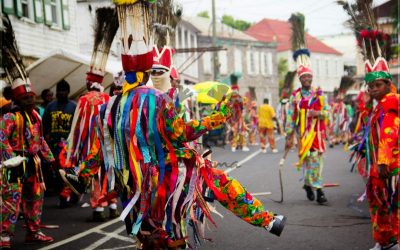
Carnival is one of the most cherished traditions on the islands. Clowns, Moko Jumbies, masquerades, bulls, and actors parade in a joyous display of island pride at Christmas. The first week of August, Emancipation Day weekend, is when Nevis celebrates Culturema, its annual cultural festival. Among the festivities are the masquerade, Moko Jumbies, Cowboys and Indians, and Plait the Ribbon, a Maypole dance.
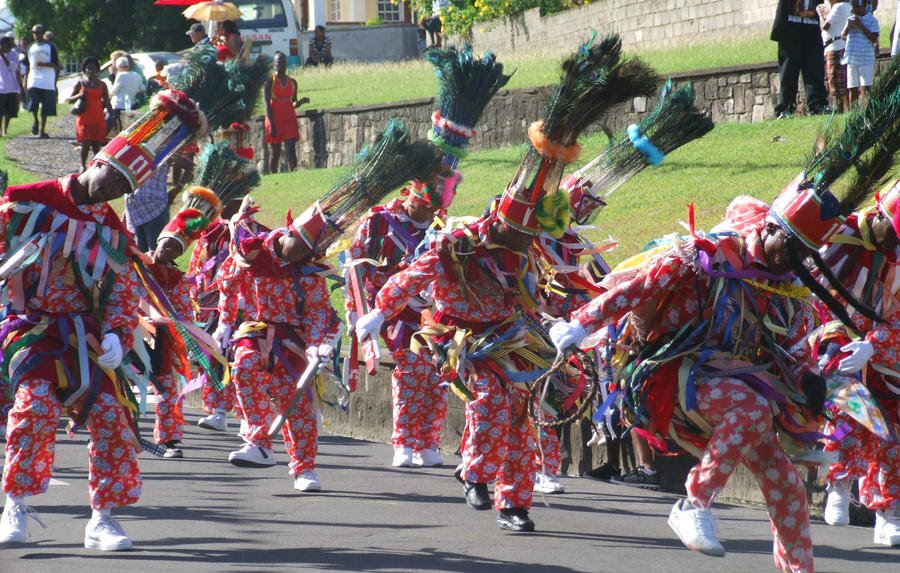
The island of Saint Kitts also hosts the Inner City Festival in February at Molineaux; the Green Valley Festival usually takes place around Whit Monday in Cayon; Easterama takes place around Easter in Sandy Point; Fest-Tabs takes place in July or August in Tabernacle; and the festival de Capisterre occurs around Independence Day in the Capisterre region. Parades, street dances, and music such as salsa, jazz, soca, calypso, and steelpan usually mark the celebrations.
Early settlement and European colonisation
Saint Kitts, originally named Saint Christopher by Christopher Columbus during his second voyage in 1493, remained inhabited by the Carib people until the arrival of European settlers. In 1623, Sir Thomas Warner and a group of English settlers established the first flourishing English colony in the West Indies at Old Road on the west coast of Saint Kitts. The French also arrived on the island in 1625, establishing their own colony under Pierre Bélain, sieur d’Esnambuc, in 1627.
During the 17th century, Saint Kitts became a battleground between the warring French and English colonists. However, in 1713, the Treaty of Utrecht granted Britain sole dominion over Saint Kitts, solidifying British control over the island. Nevis, another island in the vicinity, was sighted by Columbus in 1493 and settled by the English in 1628.
Sugar and the plantation system
The British colonisation of Saint Kitts and Nevis established the plantation system, with sugarcane becoming the dominant crop on both islands. The plantation owners, primarily absentee British landowners, relied on African slaves to cultivate and export sugarcane. Nevis, in particular, became one of the most prosperous islands in the region due to its thriving sugar industry.
However, the sugar industry also led to various challenges and changes in the islands’ socio-economic landscape. Land scarcity and price fluctuations became prevalent issues. In Nevis, soil erosion and depletion eventually led to the abandonment of sugarcane cultivation, paving the way for establishing peasant smallholdings. Despite these challenges, the plantation system shaped the history of Saint Kitts and Nevis.
Administrative configurations
Saint Kitts and Nevis experienced several administrative configurations and status changes throughout their colonial history. In 1671, they joined Antigua, Barbuda, and Montserrat as part of the Leeward Caribbee Islands Government under a British governor. This arrangement lasted until 1806, when the Leeward Caribbees were divided into separate governmental units. St. Kitts-Nevis-Anguilla and the British Virgin Islands formed one of these units.
The islands were later reunited as a single administrative entity in 1871, with the inclusion of Dominica. St. Kitts-Nevis-Anguilla became a “presidency” within the Leeward Islands Federation in 1882. They participated in the ill-fated West Indies Federation from 1958 to 1962 and later accepted the British offer of associated statehood. This allowed for domestic self-government while Britain maintained responsibility for external affairs and defence.
Independence movements and secession
The question of independence and secession played a significant role in the history of Saint Kitts and Nevis. In the late 1960s, Anguilla, a part of the federation, complained of domination by the Saint Kitts administration. In 1971, Anguilla was placed under direct British control after unsuccessful negotiations. This led to formally severing its union with Saint Kitts and Nevis in 1980.
As a result of a constitutional conference in London in 1982, Saint Kitts and Nevis became independent on 19 September 1983, despite disagreements over special provisions for Nevis.
Economic diversification and tourism
The decline in world sugar prices in the mid-1980s prompted the government of Saint Kitts and Nevis to seek alternative sources of income and reduce their dependence on sugar production. Tourism emerged as a leading industry, capitalising on the islands’ natural beauty and cultural heritage. Hosting offshore financial and service companies also contributed to the country’s economic growth.
Under the leadership of Prime Minister Kennedy Simmonds, the government focused on reducing reliance on sugar and promoting economic diversification. However, the nation faced financial challenges, including the closure of the nationalised sugar industry in 2005. Despite these setbacks, the tourism and offshore industries continued to drive the economy forward.
Political landscape and transition of power
The political landscape of Saint Kitts and Nevis witnessed significant shifts throughout its history. Under Kennedy Simmonds’s leadership, the Saint Kitts–Nevis Labour Party (SKNLP) became the independent nation’s first government in 1983. However, in 1995, the SKNLP was defeated by the People’s Action Movement (PAM) led by Denzil Douglas.
One of the key issues during Denzil Douglas’s administration was the secession movement on Nevis. Despite a referendum in 1998, the island did not achieve the required majority for independence. The decline of the sugar industry and the desire for greater control over their working lives and political situation motivated the Kittitian labourers to seek change.
In 2015, Team Unity, a coalition of opposition parties led by Timothy Harris, defeated Denzil Douglas and formed a new government. The transition of power marked a significant political shift in Saint Kitts and Nevis. The new government aimed to address economic challenges, promote transparency, and continue the diversification of the economy.
Today, Saint Kitts and Nevis continue to thrive as a vibrant nation, preserving their rich cultural heritage and embracing the opportunities of the modern world.


Leave a Reply