
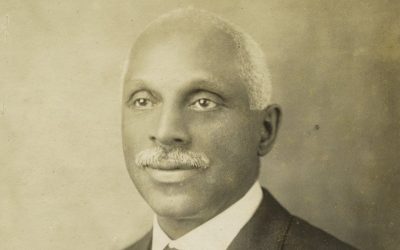
Barack Obama is the first US Black President, but he is not the first black person to run for the US presidency. That honour goes to George Edwin Taylor.
George Taylor was born in the pre-Civil War South to a free mother and an enslaved father. He went on to become the first African American chosen by a political party as its presidential candidate. Born on 4 August 1857 in Little Rock, Arkansas, Taylor was the child of Amanda Hines and Bryant (Nathan) Taylor. At age two, he moved with his mother from Arkansas to Illinois. After Amanda’s death a few years later, George fended for himself until he reached Wisconsin by paddleboat in 1865. Raised near La Crosse by a politically active black family, Taylor attended Wayland University in Beaver Dam, Wisconsin, from 1877 to 1879. He then returned to La Crosse and worked for the La Crosse Free Press and the La Crosse Evening Star. Between 1880 and 1885, he contributed newspaper columns for local papers and articles for the Chicago Inter Ocean.
Taylor’s work in the newspaper industry led him to politics, particularly labour politics. In La Crosse, he supported one of the competing labour factions and played a role in re-electing pro-labour Mayor Frank “White Beaver” Powell in 1886. Following this, Taylor emerged as a leader and officeholder within Wisconsin’s Union Labor Party. His newspaper, the Wisconsin Labor Advocate, became one of the party’s official publications.
In 1887, Taylor joined the Wisconsin delegation at the first national convention of the Union Labor Party in Ohio. He then shifted his newspaper’s focus towards national political issues. As Taylor gained prominence, his race became a topic of discussion, leading him to address African American issues more frequently. His paper ceased publication around 1887 or 1888.
In 1891, Taylor moved to Oskaloosa, Iowa, where he maintained his political interest through involvement with the Republican and Democratic Parties. While in Iowa, he owned and edited the Negro Solicitor and served as president of the National Colored Men’s Protective Association—an early civil rights organisation—and the National Negro Democratic League, which represented African Americans within the Democratic Party. Between 1900 and 1904, Taylor aligned himself with a Populist faction seeking to reform the Democratic Party.
In 1904, Taylor and other independent-minded African Americans joined the first national political party created exclusively for and by Black people – the National Liberty Party (NLP). The party held its national convention in St. Louis, Missouri, with delegates from thirty-six states. When the party’s presidential candidate ended up in an Illinois jail, the NLP Executive Committee approached Taylor to be their candidate. Although Taylor’s campaign garnered minimal attention, the party’s platform encompassed a national agenda: universal suffrage regardless of race; federal protection of all citizens’ rights; federal anti-lynching laws; additional Black regiments in the US Army; federal pensions for all formerly enslaved people; government ownership and control of public carriers to ensure equal accommodations for all citizens; and home rule for the District of Columbia.
Taylor’s presidential campaign was driven by idealism. In an interview published in The Sun (New York, 20 November 1904), he acknowledged that while white people considered his candidacy a “joke,” he believed an independent political party capable of mobilising the African American vote was the only tangible way for blacks to wield political influence. On Election Day, Taylor received a modest number of votes.
The 1904 campaign marked Taylor’s final venture into politics. He stayed in Iowa until 1910 before relocating to Jacksonville. There, he edited a series of newspapers and served as the director of the African American division of the local YMCA. Though married thrice, Taylor never had any children. George Edwin Taylor passed away in Jacksonville on 23 December 1925.


Leave a Reply