
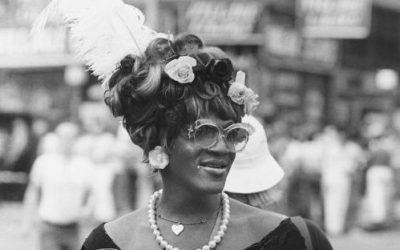
Marsha P Johnson was an outspoken transgender rights activist at the forefront of important moments in LGBTQ+ history. Her activism in the 1960s and 70s had an enormous impact on the LGBTQ+ community.
Marsha P Johnson was born Malcolm Michaels Jnr on 24 August 1945 in New Jersey, United States. It was only after leaving New Jersey for New York City at 17 that Marsha felt able to explore her feminine identity and her sexuality. Arriving in New York with just $15 and a bag of clothes, Marsha settled in Greenwich Village in 1966.
There she legally changed her name to Marsha P Johnson. When people asked her what the “P” stood for, she would reply “Pay it no mind”. This response was intended to be a rhetorical answer to the question many had on their minds as to whether she was male or female.
Flamboyant drag artist

Life was hard and Marsha earned her way as a sex worker and drag artist.
Marsha was an eccentric woman who was known for her exotic hats and jewellery. Her flamboyant sense of style and larger-than-life personality caught the attention of Pop Art legend Andy Warhol. Johnson, who mostly sourced her outfits from rubbish bins, was often seen wearing bright red heels, stacked costume jewellery, colourful wigs and dresses festooned with glittering sequins. Such elaborate looks became part of her drag persona (she was part of the drag group Hot Peaches), and were immortalised in Warhol’s 1975 polaroid series, Ladies and Gentlemen.
When she was wearing these items or any female clothing, she was Marsha P Johnson. But there were times when she went back to her male persona of Malcolm. She was more comfortable and happier in her female persona as Marsha, and being among others who also felt more comfortable in a persona that is different than the one they were born into she felt she could help.
The Stonewall Riots
During the 60s, being gay was classified as a mental illness in the United States. Gay people were regularly threatened and beaten by police, and were shunned by many in society.
Gay bars and clubs had their place in Greenwich Village and to the growing number of LGBTQ+ people it meant acceptance and salvation. There were now places to meet others who were experiencing the same bigotry and forge friendships.
Marsha was among the first drag queens to frequent Greenwich Village’s Stonewall Inn after the famous gay bar began admitting women and drag queens, rather than just gay men.
The Stonewall Riots, also called the Stonewall Uprising, began in the early hours of June 28, 1969 when New York City police raided the Stonewall Inn. The police forced over 200 people, employees and patrons alike, out of the bar and onto the streets, and then used excessive violence against them.
The raid sparked a riot and Stonewall patrons were joined by those who frequented other lesbian and gay bars in the Village and members of the local community. In the days that followed Masha became a central figure in the uprising. Protests and violent clashes with law enforcement outside the bar on Christopher Street, in neighbouring streets and in nearby Christopher Park, lasted for six days. The Stonewall Riots served as a catalyst for the gay rights movement in the United States and around the world.
A month after the protests, the first openly gay march took place in New York – a pivotal moment for the gay and trans community everywhere.
STAR
In the early 1970s Marsha, along with her friend and fellow gay rights activist, Sylvia Rivera, co-founded Street Transvestite Action Revolutionaries (STAR) – one of the first transgender rights organisations in the country. Keeping other transgenders off the streets the organisations was primary goal.
Johnson dedicated much of her life to helping others, despite suffering several mental health breakdowns that meant she was in and out of psychiatric hospitals.
Unsolved case
Marsha P Johnson tragically died in 1992 at the age of 46. She went missing and six days later police found Marsha’s body in the Hudson River in New York. Police and investigators ruled her death as a suicide, but many friends argued this ruling at the time, saying attacks on gay and trans people were common.
Others said they saw Marsha being harassed by a group of “thugs” a few days before they died.
Twenty years later, in 2012, campaigner Mariah Lopez was successful in getting the New York police department to reopen Marsha’s case as a possible murder.
Today Marsha’s legacy lives on within the LGBTQ+ community and beyond.


Leave a Reply